|
Focus On This | Renewable Energy
The power sector is the largest contributor to global CO2 emissions, with power generation representing over 60% of Greenhouse Gas emissions (GHGs). Projections indicate an 80% increase in global electricity demand by 2030, and under business as usual scenarios, potentially irreversible climate change will result from ever-increasing GHG emissions. Unless clean energy solutions are deployed with urgency and at scale, target CO2 emission levels will not be met in the medium-term, and the pace of climate change will continue to accelerate.
There is an emerging global consensus on the need to implement climate change mitigation strategies that will drastically reduce our dependence on existing and polluting, power generation technologies. In addition to the need for climate change mitigation, there is a growing demand for clean energy for a variety of economic and social reasons: increasing costs of fossil fuel power generation, security of supply and energy independence, geo-political imperatives, economic development, wealth and job creation advantages.
There are a limited number of technologies capable of making a material contribution to our need for renewable energy in the medium-term. Solar, Hydro, Wind, Geothermal, Wave and Tidal will all play a role in the new energy generation portfolio mix. Currently, renewable energy represents a small fraction of global power supply—some 2% of total generation, excluding hydro. Fossil fuel-generated energy prices are escalating and remain volatile because of fuel supply constraints and carbon regulation, while renewable energy generation costs continue to decline. As a result, the energy pathway of the 21st Century is becoming clearer.
|
Is Anyone Concentrating | CSP
There is enough sunlight that reaches the Earth’s surface in one hour to meet all our energy needs for the entire year. Concentrating Solar Power (CSP) is one of the most promising sources of renewable energy for the 21st Century. The first parabolic trough system was built in Egypt in 1912 and CSP technologies have been in existence at small scale and on an isolated basis for some time. During the oil crisis of the 1970’s, significant strides were made in the deployment of utility-scale solar thermal projects, and again with commitments from governments, CSP has enjoyed a renaissance in some markets. However, with the growing global need for large-scale clean energy solutions, CSP is poised to become the leading technology for delivering utility scale power in high-growth markets around the world.
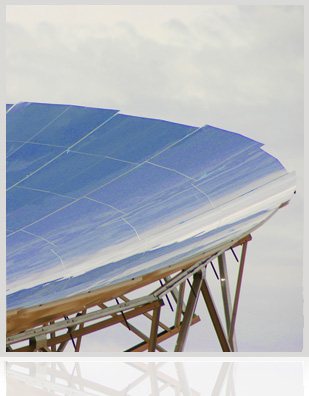
CSP systems fall within four broad technology bands: Parabolic Trough; Power Tower; Compact Linear Fresnel Reflector (CFLR); and Dish Stirling Systems. Parabolic Trough, Power Tower, and CLFR all focus sunlight to heat water and produce steam, which is then converted to electrical energy in a conventional steam turbine generator. The Dish Stirling Engine system, of which the SunCatcher is the leading commercial technology, uses a large parabolic dish to concentrate sunlight onto a single receiver point above the dish. Within the receiver, a thermal fluid is heated and used to generate electricity in a Stirling engine attached to the receiver. Dish systems are the only CSP technology to use a highly efficient Stirling engine, rather than a steam turbine, to convert heat to electricity.
CSP has several advantages over traditional photovoltaic (PV) electric technologies that convert the sun’s energy directly into electricity—namely cost/efficiency advantages and the ability to generate large, utility grid-scale power.
Advanced CSP technologies are making it possible to generate clean and renewable utility-scale power from the sun’s rays. The SunCatcher Dish Stirling System is one of the most highly efficient and commercially available solar solutions ever developed.
|



